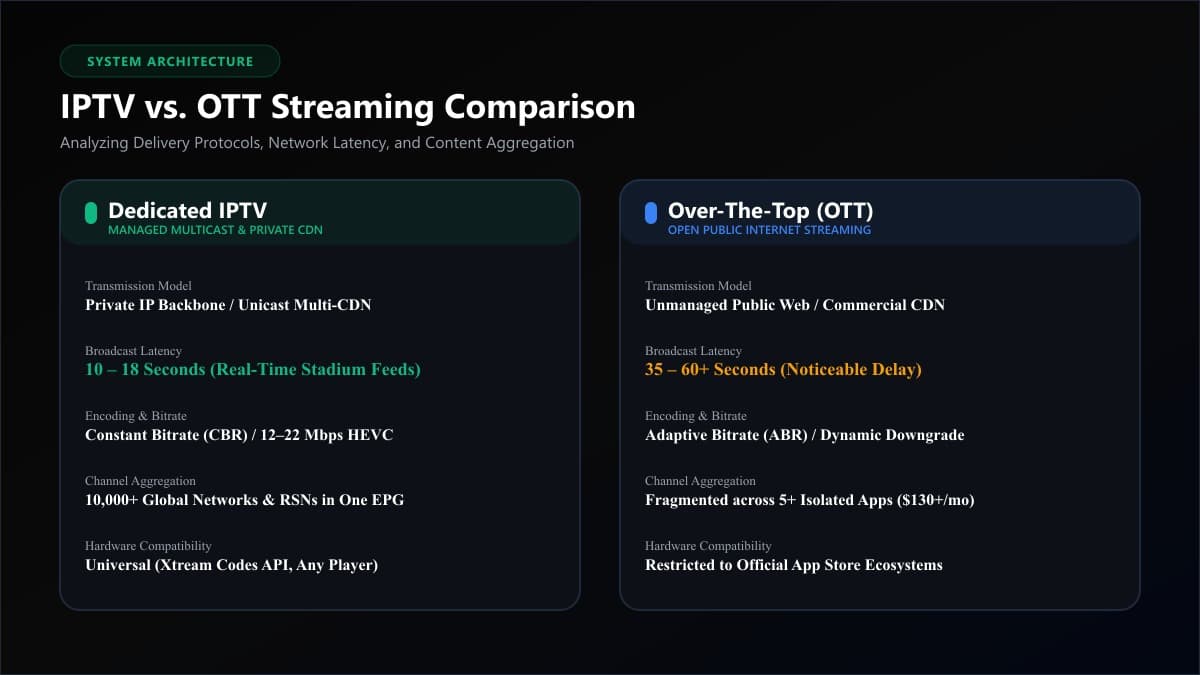
The shift away from traditional broadcast television has popularized two terms: IPTV (Internet Protocol Television) and OTT (Over-The-Top). While both technologies deliver video over digital networks rather than analog antennas or coaxial cables, they are engineered on fundamentally different principles.
Many viewers mistakenly assume IPTV and OTT are interchangeable synonyms for "streaming." In reality, the difference between them dictates everything from your video quality, broadcast latency, and hardware freedom to your monthly subscription bills.
Understanding the differences between iptv vs ott is crucial for cord-cutters. Whether you want to eliminate monthly cable rental fees, follow live international sports without broadcast blackouts, or build a flexible multi-room entertainment system, this guide provides an engineering-grade breakdown of both technologies, compares their performance, and helps you determine which platform best suits your viewing habits.
1. Defining the Core Concepts: IPTV vs OTT
To understand how both systems function, we must first examine how their signals travel from content servers to your television screen.
What is IPTV (Internet Protocol Television)?
IPTV delivers television programming over internet protocol suite networks. Traditionally, IPTV referred to closed, private, managed networks operated by telecommunications providers (such as AT&T U-verse, Verizon Fios, or British Telecom).
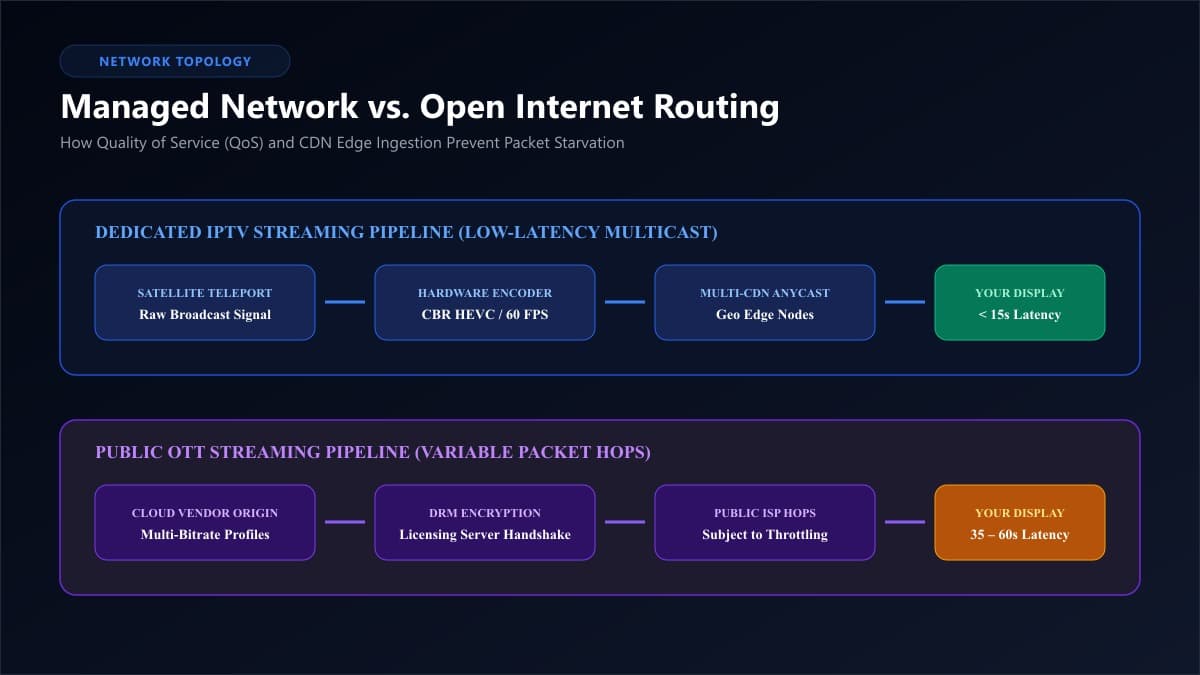
In this managed environment, the provider allocates dedicated bandwidth specifically for video packets. Even if everyone in your neighborhood is heavily downloading files, your television stream never stutters because the network operator enforces strict Quality of Service (QoS) rules prioritizing video packets.
In the modern cord-cutting ecosystem, IPTV has evolved into a global, unbundled streaming format. Providers ingest satellite and fiber broadcast feeds and distribute them via dedicated server clusters using protocols like MPEG-TS and HLS, allowing subscribers to access organized live channel bouquets using third-party player apps like TiviMate. Discover how modern IPTV architectures operate in our deep-dive guide.
What is OTT (Over-The-Top)?
OTT refers to content delivered directly over the open, public internet, bypassing traditional telecommunications infrastructure. Examples of OTT services include subscription video-on-demand (SVOD) platforms like Netflix, Disney+, and Max, as well as live virtual multichannel video programming distributors (vMVPDs) like YouTube TV, Sling TV, and Fubo.
Because OTT content travels across the unmanaged public internet, providers have no control over the intermediate network hops between their cloud servers and your router. To prevent stream interruptions when internet congestion occurs, OTT platforms rely on Adaptive Bitrate (ABR) streaming, dynamically lowering video resolution to keep playback running.
┌─────────────────────────────────────────────────────────────────────────┐
│                     IPTV VS OTT NETWORK ARCHITECTURE                    │
├─────────────────────────────────────────────────────────────────────────┤
│  IPTV: [Broadcast Source] ──► [Managed Server Cluster] ──► [Your Screen]│
│        (Dedicated QoS Bandwidth | Fixed Bitrate | Sub-15s Latency)      │
│                                                                         │
│  OTT:  [Cloud Storage] ──► [Public Internet / Multi-CDN] ──► [Your App] │
│        (Unmanaged Routing | Adaptive Bitrate Fallback | 30-60s Delay)   │
└─────────────────────────────────────────────────────────────────────────┘
2. Key Technical Differences: Network, Quality & Latency
Comparing iptv vs ott requires evaluating five essential technical pillars:
| Technical Metric | Dedicated IPTV | Over-The-Top (OTT) | Real-World Viewing Impact |
|---|---|---|---|
| Network Infrastructure | Managed IP / Private CDNs | Public, open internet | IPTV offers packet prioritization; OTT relies on public web health. |
| Bitrate Encoding | Constant Bitrate (CBR) | Adaptive Bitrate (ABR) | IPTV maintains fixed crispness; OTT drops quality during spikes. |
| Broadcast Latency | 10 – 18 Seconds | 35 – 60+ Seconds | IPTV keeps sports in real time; OTT causes phone notification spoilers. |
| Channel Aggregation | 10,000+ Global in one EPG | 85 – 150 Domestic Channels | IPTV unites global feeds; OTT is limited by regional licensing. |
| Hardware Flexibility | Universal (Any app / box) | Restricted store apps | IPTV runs on open players; OTT requires approved vendor apps. |
| Cost Structure | $12 – $20 / month | $80 – $120+ / month | IPTV provides massive savings across live sports and global channels. |
Because IPTV providers typically utilize Constant Bitrate (CBR) encoding with H.265/HEVC, the picture remains razor-sharp regardless of on-screen motion complexity. This makes IPTV particularly dominant for fast-action sports broadcasting. Learn more in our live sports IPTV streaming guide.
3. Content Availability and Channel Aggregation
The difference in content structure between iptv vs ott represents one of the strongest arguments for modern cord-cutters.
The Fragmentation Trap of OTT
Mainstream OTT streaming was originally praised for simplicity. Today, however, sports and entertainment rights are fractured across dozens of competing walled gardens:
- YouTube TV / Fubo ($80/mo) for baseline TV
- Peacock / Paramount+ ($16/mo) for exclusive games
- Standalone Regional Sports Apps ($20–$30/mo)
- Total: $130+/mo across multiple isolated apps
The Unified Interface of Modern IPTV
An IPTV subscription eliminates app-switching by organizing global television into a single, standardized Electronic Program Guide (EPG):
- Domestic Broadcast Networks (ABC, CBS, NBC, FOX)
- Regional Sports Networks without blackouts
- Global stadium feeds (Sky, TNT, Optus, DAZN)
- Unified access for roughly $15/month
For an in-depth breakdown of sports packages, review our sports IPTV subscription guide.
4. Hardware Ecosystem and User Experience
How you interact with IPTV and OTT on your living room television differs significantly:
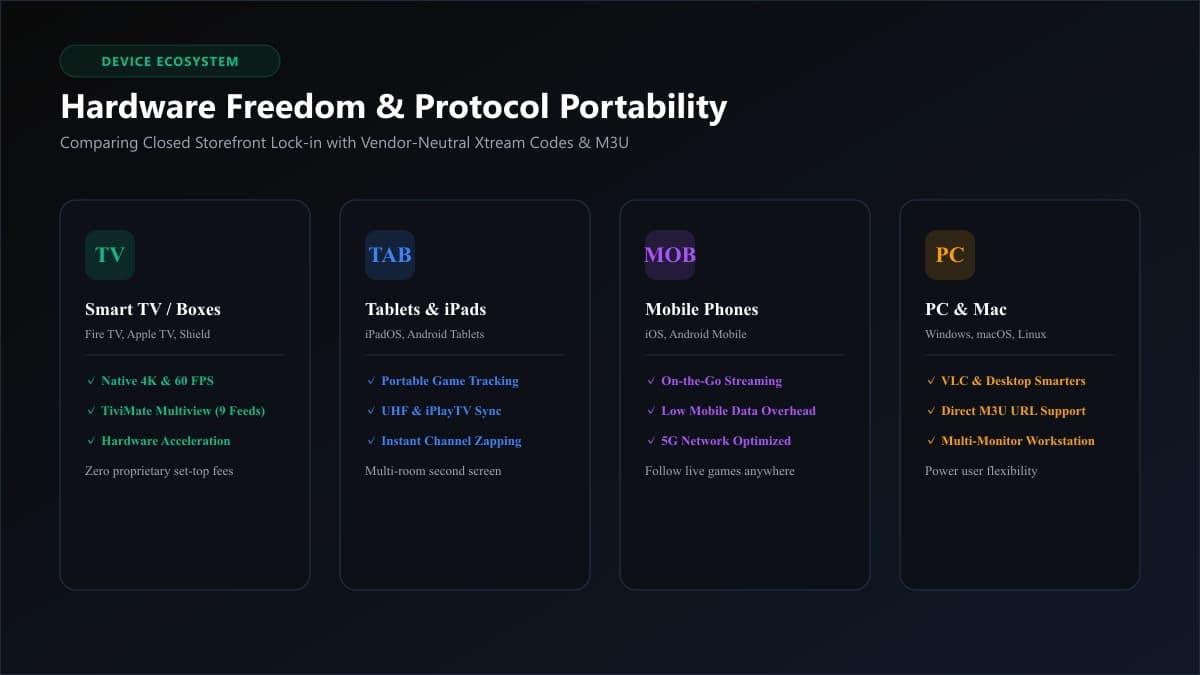
One of the most powerful features of modern IPTV players is custom multiview. While OTT platforms like YouTube TV offer limited, preselected "mosaic" multiviews for select football games, IPTV applications allow you to build custom grids of two, three, or four simultaneous channels. Check our list of supported streaming hardware for top player configurations.
5. Cost Comparison: The Financial Reality
When comparing iptv vs ott, pricing is often the most dramatic deciding factor:
| Category | Mainstream OTT Live TV Stack | Dedicated IPTV Platform (nobiptv) |
|---|---|---|
| Base Monthly Cost | $79.99 / month | $12.00 – $20.00 / month |
| Sports Add-on Packages | $15.00 – $25.00 / month | Included ($0.00) |
| Out-of-Market Passes | $300 – $400 / season | Included ($0.00) |
| Blackout Limitations | Strictly enforced by GPS/IP | Bypassed via global regional feeds |
| Estimated Annual Expense | $1,200 – $1,600+ / year | $140 – $180 / year |
By switching to IPTV subscription packages, cord-cutters routinely save between $1,000 and $1,400 annually while gaining access to a vastly larger catalog of live international channels and sports feeds.
6. The Rise of "Hybrid IPTV" in 2026
The historical boundary separating IPTV and OTT has blurred into what telecommunications engineers call Hybrid IPTV:
- Modern CDN Distribution: Today's top-tier IPTV services no longer require proprietary ISP-issued set-top boxes. Instead, they ingest broadcast signals via satellite and deliver them over globally distributed Content Delivery Networks (CDNs) using OTT-style IP transport.
- Anti-Freeze Load Balancing: By deploying Anycast routing and multi-edge server caching, modern IPTV providers achieve the carrier-grade reliability of traditional managed IPTV while retaining the universal device freedom of OTT apps. Explore our anti-freeze streaming features to see how dynamic load balancing prevents buffering.
7. Which One Should You Choose?
Choose OTT If:
- You primarily watch on-demand prestige series (Netflix, Max).
- You rarely watch live sports or scheduled broadcast TV.
- You prefer closed, simplified single-app experiences.
- You do not mind paying separate subscription fees per service.
Choose IPTV If:
- You love live television, breaking news, and 60FPS sports.
- You want out-of-market games without local blackouts.
- You want a single, organized 7-day Electronic Program Guide.
- You want to reduce your television bill by over 80%.
To get started, follow our comprehensive guide on how to subscribe to IPTV safely.
8. Frequently Asked Questions
What is the main difference between IPTV and OTT?
The primary difference is network infrastructure. Traditional IPTV operates over a private, managed network with dedicated bandwidth and guaranteed Quality of Service (QoS). OTT delivers video over the open, unmanaged public internet using adaptive bitrate streaming.
Is IPTV better than OTT for live sports?
Yes. Dedicated IPTV services typically use Constant Bitrate (CBR) encoding with native 50/60 FPS frame rates and low transmission latency (sub-18 seconds). OTT live TV services often introduce 35–60 seconds of delay and lower video bitrates during fast camera movements.
Do I need a special set-top box for IPTV?
No. While traditional telecom IPTV required rented proprietary boxes, modern IPTV platforms operate over open standards like Xtream Codes API. You can stream seamlessly on any Amazon Firestick, Apple TV, Android TV box, smart television, or mobile device.
Can I use IPTV and OTT services on the same device?
Yes. Modern streaming devices (such as an Apple TV 4K or Amazon Fire TV Stick 4K Max) can run both official OTT apps (like Netflix or Prime Video) and dedicated IPTV players (like TiviMate or iPlayTV) side-by-side.
Why is IPTV so much cheaper than OTT live TV packages?
Mainstream OTT bundles (such as YouTube TV or Hulu + Live TV) incur massive domestic rebroadcasting licensing fees and pass high advertising surcharges onto consumers. IPTV utilizes lean cloud distribution infrastructure without expensive legacy overhead, delivering massive savings to end subscribers.
Experience the Power of Hybrid IPTV with nobiptv
Get 10,000+ live channels, 60FPS sports feeds, and uncompressed 4K streams with carrier-grade stability on any device.