
For decades, watching live television in the United States meant being tied to physical coaxial cables, satellite dishes mounted to rooftops, and clunky proprietary set-top boxes rented from regional telecom monopolies. Every month, American households opened their billing statements to find ever-increasing rates accompanied by mysterious "broadcast TV surcharges," "regional sports fees," and equipment rental costs.
Today, television delivery has undergone a fundamental transformation. Internet Protocol Television—commonly known as IPTV—routes live television broadcasts, news networks, sports feeds, and on-demand entertainment over standard internet protocol packets rather than legacy radio-frequency cables.
Whether you are looking to slash a $200 monthly cable bill, consolidate fragmented streaming subscriptions, or understand the technology and legal landscape, this comprehensive guide explains everything you need to know about iptv in usa. We break down how the technology works, what programming American viewers can access, how to identify reliable services, and how to configure your home network for flawless streaming.
1. What Is IPTV and How Does It Work in the United States?
At its core, IPTV stands for Internet Protocol Television. Instead of transmitting television programs through radio signals beamed from ground antennas, light pulses over closed coaxial television lines, or microwave transmissions from satellite dishes, IPTV encodes video into digital data packets and delivers them via standard broadband internet.
[Traditional Cable Television]
[Broadcaster] ──► [Headend Facility] ──► [Coaxial Lines] ──► [Cable Box] ──► TV
* Constant signal across all channels simultaneously, requiring physical coaxial wiring.

[Internet Protocol Television (IPTV)]
[Broadcaster] ──► [Transcoder] ──► [CDN Edge Servers] ──► [Broadband] ──► [App / Smart TV]
* On-demand packet streaming: only the specific channel you watch is transmitted.
Live Television
Real-time streaming of linear broadcasts as they happen—including local morning news, primetime network series, and live sporting events.
Catch-Up & Timeshift
Server-side recorded broadcasts allowing viewers to scroll backward through the EPG to replay missed programs without dedicated physical DVR hardware.
Video on Demand
A centralized, organized catalog of on-demand movies and full television series that can be streamed instantly at any time.
2. The Great American Cord-Cutting Shift
The surge in demand for IPTV across the United States is driven primarily by consumer revolt against traditional pay-TV pricing. Millions of American households disconnect from cable and satellite providers each year due to specific structural frustrations:
Hidden Surcharges & Equipment Fees
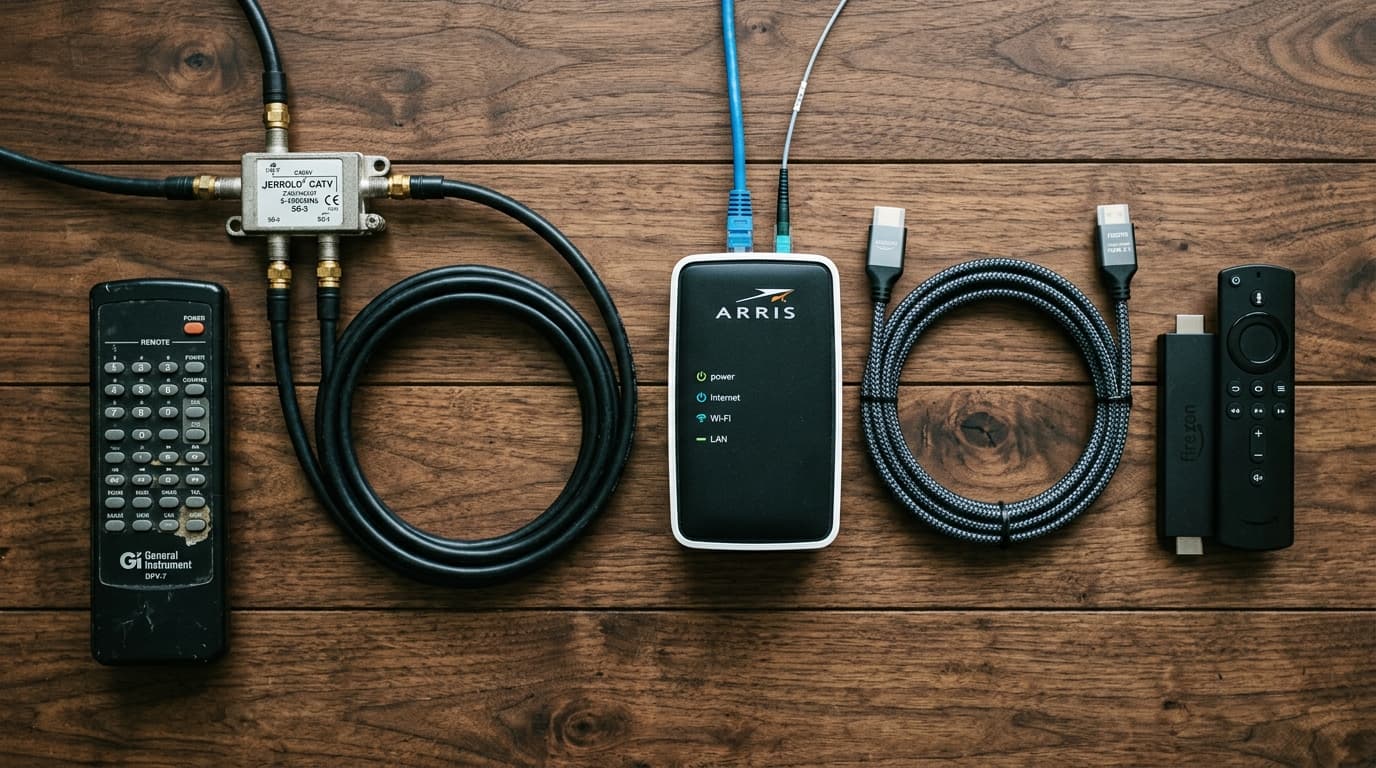
Traditional cable companies layer monthly bills with mandatory add-ons: Broadcast TV Fees ($18–$28/mo), Regional Sports Fees ($12–$18/mo), and box rental fees ($10–$15 per TV/mo).
The Streaming Fragmentation Trap
Subscribing to YouTube TV, Peacock, Paramount+, ESPN+, and Max costs $160+/mo while requiring viewers to constantly juggle separate apps.
3. Understanding the Legal Landscape in the United States
One of the most common questions regarding IPTV in the USA is: Is IPTV legal?
As a technological delivery mechanism, IPTV is 100% legal in the United States. Major telecom providers (YouTube TV, Sling TV, Fubo, and DirecTV Stream) all use IPTV technology. The legal distinction rests entirely on content distribution licensing:
Licensed Broadcast Services
Platforms that negotiate direct retransmission consent agreements with broadcast networks and pay royalties under the FCC and US Copyright Act.
Third-Party Independent Platforms
Independent streaming providers aggregate feeds across global networks. US legal enforcement historically focuses on unauthorized commercial operators rather than passive home viewers, but users should prioritize transparent, secure providers with verified reputations.
4. What American Viewers Expect from a US Channel Lineup
To serve as a genuine replacement for traditional cable, an IPTV service operating in the USA must satisfy distinct regional programming expectations across multiple categories:
Local Affiliate Networks Across Major Media Markets
American viewers rely on local affiliate stations for news, weather emergencies, and local sports. Quality services supply ABC, CBS, NBC, and FOX feeds across major designated market areas (DMAs) such as New York, Los Angeles, Chicago, Dallas, and Atlanta, alongside East Coast and West Coast feeds.
Regional Sports Networks (RSNs) with Zero Blackouts
Comprehensive coverage of FanDuel Sports Network (formerly Bally Sports), YES Network, NESN, Marquee, and NBC Sports Regionals allows fans to follow hometown baseball, basketball, and hockey teams without blackout restrictions. Compare options in our guide on best IPTV for sports.
Synchronized Multi-Time-Zone Electronic Program Guide
A localized US electronic program guide synchronizes channel listings across Eastern (EST), Central (CST), Mountain (MST), and Pacific (PST) daylight savings schedules.
5. Technical Realities: Streaming IPTV Across the USA
The United States presents distinct physical and networking challenges that directly influence stream stability:
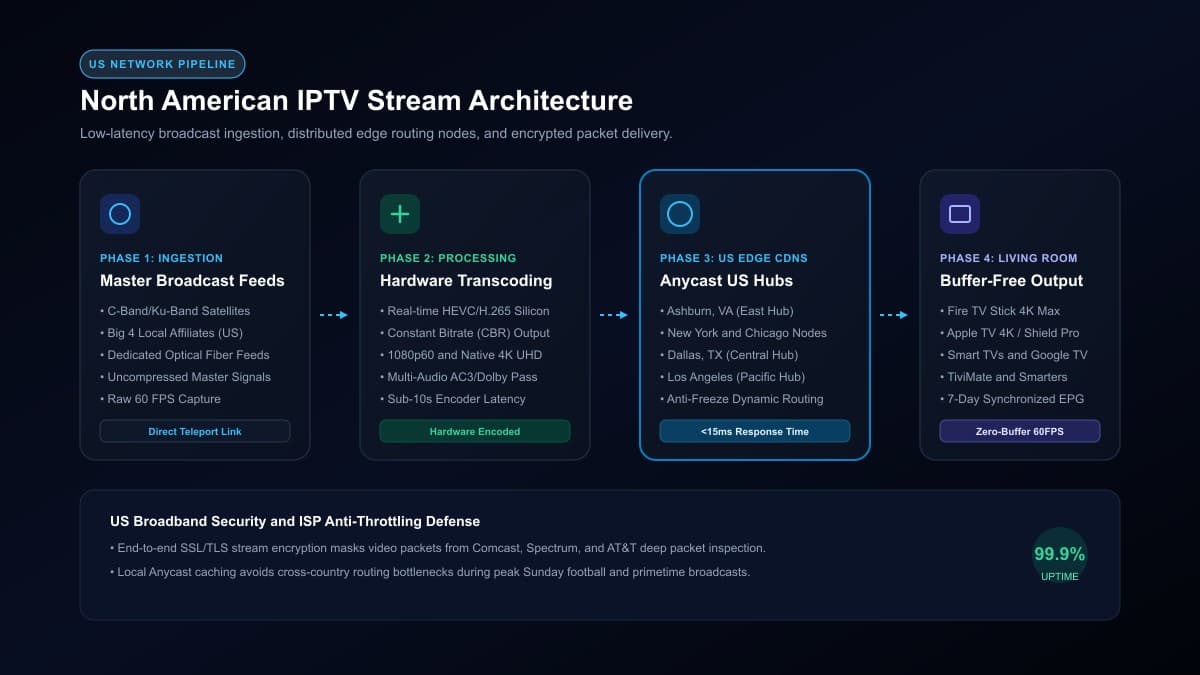
North American Edge CDN Nodes
Routing packets across 3,000 miles from overseas servers leads to high latency (>150ms) and sluggish channel switching. Quality providers deploy edge nodes in Ashburn, NY, Chicago, Dallas, and LA for sub-15ms response times. Learn more in our 4K IPTV USA streaming guide.
Neutralizing Domestic ISP Throttling
Major US internet providers (Comcast, Spectrum, AT&T) employ deep packet inspection to throttle video ports during Sunday sports. Encrypted SSL/TLS transport pipelines prevent ISPs from identifying and shaping your stream. Read our tips on how to troubleshoot IPTV buffering and playback issues.
6. Supported Hardware and Apps in American Homes
Unlike traditional cable that mandates proprietary rented set-top boxes, IPTV runs on standard consumer devices:
| Device | Operating System | Key Advantages | Recommended Player Apps |
|---|---|---|---|
| Amazon Fire TV Stick 4K Max | Fire OS | Low cost, Wi-Fi 6E, fast sideloading | TiviMate, Smarters Pro, XCIPTV |
| Apple TV 4K (3rd Gen) | tvOS | A15 Bionic speed, smooth 60FPS UI | GSE Smart IPTV, IPTVX, UHF |
| NVIDIA Shield TV Pro | Android TV | Gigabit Ethernet, Multi-View support | TiviMate, iMPlayer, OTT Navigator |
| Google TV / Chromecast (4K) | Google TV | Native Play Store, clean interface | Televizo, Smarters Pro, Sparkle TV |
*Explore our detailed guide on best IPTV apps for Firestick for step-by-step installation instructions.
7. How to Get Started with IPTV in the USA: A Step-by-Step Checklist
Follow this practical setup sequence to transition your home entertainment to IP streaming:
1. Test Your Broadband Speed
Confirm your home internet delivers at least 25 Mbps download bandwidth with low jitter. Connect your streaming hardware to 5 GHz Wi-Fi or hardwired Ethernet. See our recommended internet speeds for streaming.
2. Set Up a Capable Streaming Stick
Connect an Amazon Fire TV Stick 4K Max or Apple TV 4K to your display. Follow our Firestick IPTV setup guide.
3. Install an Optimized Player App
Sideload TiviMate or install IPTV Smarters Pro to manage channel playlists and EPG guides.
4. Test with a 24-Hour Free Trial
Request a test stream during US primetime hours (8:00–10:30 PM EST) to verify server stability under peak load. Get started with an IPTV with free trial.
8. Frequently Asked Questions
What does IPTV stand for and how is it used in the USA?
IPTV stands for Internet Protocol Television. In the United States, it describes the delivery of live television channels, sports broadcasts, and on-demand movies over the internet rather than through traditional coaxial cable or satellite dish infrastructure.
Can I replace my cable subscription entirely with IPTV?
Yes. A comprehensive IPTV service provides the full scope of American television: local ABC, CBS, NBC, and FOX broadcast stations, national cable networks (ESPN, CNN, HGTV, USA), Regional Sports Networks, premium movie channels, and on-demand libraries—all accessible through an on-screen electronic program guide. Read our review on evaluating the best IPTV in USA.
Why do some IPTV services buffer on American internet connections?
Buffering is typically caused by three factors: servers located overseas with high network latency, domestic ISP bandwidth throttling during peak sports matches, or overloaded reseller panels during primetime hours. Utilizing low-latency North American edge servers with SSL encryption eliminates these bottlenecks.
Do I need a VPN to stream IPTV in the United States?
While not mandatory on high-speed fiber connections, using a reputable VPN is recommended if your Internet Service Provider (such as Comcast or Spectrum) actively throttles streaming video traffic or if you want to ensure complete privacy for your home internet browsing.
How does IPTV handle multiple TVs in a single household?
Most quality providers offer multi-connection subscription plans (such as 2, 3, or 4 simultaneous screens). This allows multiple family members to watch live sports in the living room, news in the kitchen, and movies in the bedroom simultaneously using one master account.
Upgrade Your Living Room with nobiptv
Get local US broadcast networks, blackout-free regional sports, 60FPS fluid motion, and dedicated North American CDN routing at a fraction of traditional cable costs.